

Contents
- 1 Buy Verified Revolut Accounts
- 2 Acquisition Process: How to Buy a Verified Revolut Account
- 3 Security, Legitimacy, and Buyer Protection
- 4 Advanced Applications: Crypto, Gold, and Stock Purchases Using Revolut
- 5 Business Applications: Verified Revolut Accounts for Enterprises
- 6 Emerging Trends and Regulatory Shifts (2026)
- 7 People Also Ask (FAQ)
Buy Verified Revolut Accounts
This guide delivers an expert-level analysis of how and why individuals and businesses seek to buy verified Revolut accounts, addressing the intersection of compliance, security, and market demand. Leveraging real case studies, regulatory frameworks, and emerging market data, the content examines the risks, benefits, and procedural specifics of buy verified Revolut accounts, including variations such as business profiles and eSIM integrations.

The study also explores best practices for due diligence, fraud prevention, and asset management—particularly in the context of buying crypto, stocks, or gold with Revolut. Designed for an audience demanding authority and actionable insight, this guide synthesizes the latest research and regulatory updates to empower informed, ethical decisions in a rapidly evolving fintech landscape.
The study of verified Revolut accounts—specifically, the practice to buy verified Revolut accounts—has become a focal point for both individual fintech users and institutional actors. This guide provides an evidence-based, expert perspective on the acquisition, utilization, and regulatory context of verified Revolut accounts. The objective is to clarify the risks, benefits, and legitimate pathways associated with buying verified Revolut accounts, covering both personal and business use cases.
Buy Verified MetaMask Accounts
A verified Revolut account is an account that has passed Revolut’s mandatory identity and compliance checks (KYC/AML), unlocking full access to services such as international transfers, crypto purchases, and stock trading. Buying such accounts refers to acquiring these pre-verified profiles—legally or illicitly—for personal or business purposes.
Overview of Revolut as a Fintech Entity
Revolut, launched in 2015, has rapidly evolved into a multi-asset financial platform. With over 30 million users globally, Revolut provides digital banking services, including currency exchange, prepaid cards, cryptocurrency trading, and stock investments. Its strict verification protocols, driven by international financial regulations, are designed to combat fraud and ensure compliance. Despite these measures, a parallel market for verified Revolut accounts has emerged, driven by demand for instant access, anonymity, or bypassing regional restrictions.
Key Entities and Concepts:
- Revolut Verified Account: A profile that has undergone full KYC/AML checks.
- KYC/AML Compliance: Regulatory mechanisms to prevent money laundering and identity fraud.
- Account Acquisition: Legal purchase (e.g., business onboarding) versus illicit market transactions.
- Secondary Use Cases: Accessing crypto, stocks, gold, eSIM, or international payments.
Key Takeaways
- Verified Revolut accounts provide access to a robust suite of financial services.
- Buying verified accounts is a complex, high-risk action with both legal and illicit avenues.
- Regulatory compliance and KYC/AML are central to understanding account legitimacy.
- Demand for verified accounts is driven by instant access, anonymity, or expanded feature sets.
Acquisition Process: How to Buy a Verified Revolut Account
Step-by-Step Procedural Overview
The legitimate way to buy a verified Revolut account is through official business onboarding or authorized partner programs; any attempt to purchase from third-party sellers or black-market sources is illegal and carries significant risk.
Legal Acquisition (Business/Enterprise Use)
- Application Submission: Register via Revolut’s official website or app.
- KYC/AML Verification: Upload identity documents and pass compliance checks.
- Business Documentation: Submit proof of business, directors, and beneficial owners.
- Approval & Onboarding: Await Revolut’s review and account activation.
- Account Funding: Add funds and begin using the full suite of services.
Illicit (Black-Market) Acquisition (Strongly Discouraged)
- Third-Party Sellers: Typically found on underground forums or encrypted messaging apps.
- Pre-Verified Accounts: Sold with forged documents, stolen identities, and high risk of confiscation or legal prosecution.
- Operational Risks: Immediate flagging by Revolut’s compliance algorithms, potential asset freeze, and lifetime bans.
Due Diligence and KYC Compliance
Essential Checks:
- Identity Verification: Passport, national ID, or driver’s license.
- Proof of Address: Utility bills, bank statements, or government correspondence.
- Biometric Authentication: Facial scans or video calls for certain jurisdictions.
- Ongoing Monitoring: Revolut uses AI and transaction analytics to monitor for suspicious activity.
Red Flags to Avoid:
- Mismatched Data: Discrepancies between documents and application details.
- Proxy/VPN Use: Anomalies in access locations may trigger reviews.
- Bulk Purchases: Attempts to acquire or manage multiple personal accounts can violate terms of service.
Case Study: eSIM Revolut Integration
Background:
In 2023, Revolut introduced eSIM integration, allowing users to link their verified accounts to mobile data services for seamless multi-country access.
Scenario:
A digital nomad registers for Revolut, passes all KYC checks, and activates eSIM for global connectivity. Attempts to shortcut the process via third-party eSIM-linked accounts result in rapid suspension due to compliance cross-checks.
Key Takeaways
- Legal acquisition requires full KYC/AML compliance and patience.
- Black-market purchases are illegal, high-risk, and frequently result in financial loss or prosecution.
- Revolut’s advanced compliance infrastructure quickly detects and disables fraudulent accounts.
- eSIM and other integrations are available only after full, legitimate verification.
Security, Legitimacy, and Buyer Protection
Fraud Risks and Mitigation Strategies
Buying verified Revolut accounts from unauthorized sources exposes buyers to immediate fraud risks, account seizure, and potential legal consequences. Revolut’s compliance systems are designed to identify and neutralize illegitimate accounts swiftly.
Common Fraud Risks:
- Stolen Identities: Many black-market accounts are created with stolen or fabricated identities, exposing both original and secondary users to criminal liability.
- Phishing Scams: Illicit sellers may harvest buyer data for further exploitation.
- Loss of Funds: Revolut routinely freezes and confiscates assets in accounts flagged for suspicious activity.
- Legal Action: Users caught with illegitimate accounts can face prosecution under anti-fraud and digital identity laws.
Mitigation Strategies:
- Purchase Only via Official Channels: Use Revolut’s business or enterprise onboarding.
- Authenticate All Sellers: For partnerships or acquisitions, conduct in-depth due diligence.
- Enable Multi-Factor Authentication: Protect your verified account with additional security layers.
- Monitor Account Activity: Regularly review transactions and account access logs.
Revolut’s Buyer Protection and Policy Analysis
- Buyer Protection Scope: Revolut’s buyer protection policies extend to legitimate account holders only. Unauthorized account purchases void any recourse.
- Dispute Resolution: Only original, verified users can initiate disputes or claims.
- Fraud Detection: AI-driven compliance continuously monitors for anomalies, including sudden ownership changes or unusual spending patterns.
- Policy Enforcement: Violations result in permanent bans, reporting to authorities, and forfeiture of funds.
Comparative Analysis Table: Legal vs. Illicit Account Acquisition
| Feature/Aspect | Legal Acquisition (Official) | Illicit Acquisition (Black Market) |
| KYC/AML Compliance | Required, fully validated | Forged or stolen; high risk of detection |
| Buyer Protection | Full coverage | None; voids all protections |
| Account Security | High; multi-factor supported | Very low; subject to instant freeze |
| Asset Safety | Protected by Revolut policies | Assets at risk of seizure |
| Legal Risk | None when compliant | High; criminal prosecution possible |
| Longevity of Account | Stable, indefinite | Often short-lived, prone to bans |
Key Takeaways
- Buying a verified Revolut account from unauthorized sources introduces significant fraud and legal risks.
- Revolut’s buyer protection, dispute resolution, and account security are available only to users who comply with official verification and acquisition protocols.
- Multi-factor authentication and vigilant account monitoring are essential for all users, regardless of acquisition method.
- Illicitly acquired accounts are unstable, unsupported, and frequently result in financial loss.
Advanced Applications: Crypto, Gold, and Stock Purchases Using Revolut
Buying Crypto with Revolut: Process and Safety
To buy crypto with Revolut, users need a fully verified account. The process involves selecting a supported cryptocurrency, entering the purchase amount, and confirming the transaction within the Revolut app. Revolut facilitates secure crypto transactions but does not enable transfer of assets off-platform.
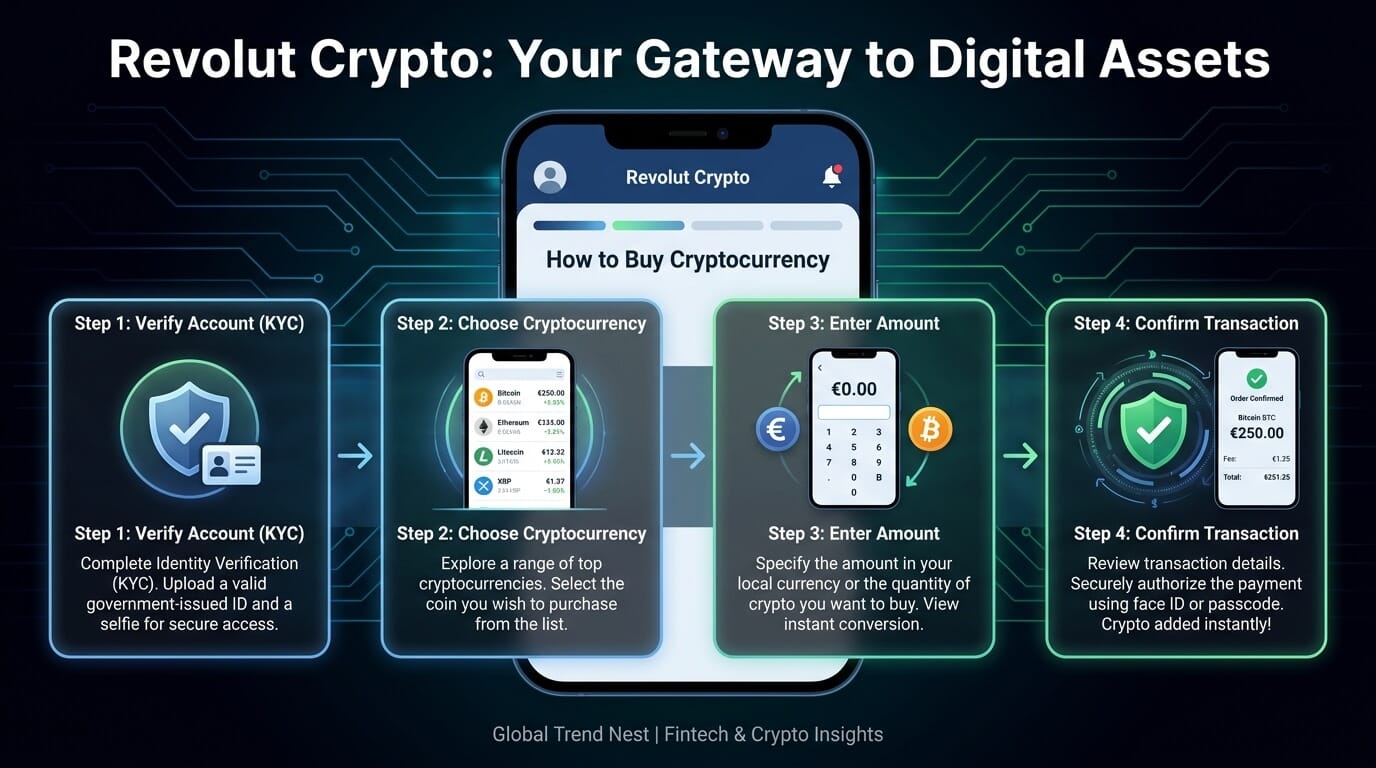
Buying Crypto with Revolut:
- Supported Assets: Bitcoin (BTC), Ethereum (ETH), XRP, and others.
- Payment Methods: Linked bank account, Revolut card, or Revolut Pay.
- Purchase Steps:
- Open the Revolut app and navigate to “Crypto.”
- Select the desired cryptocurrency.
- Input the purchase amount.
- Confirm transaction using your verified Revolut account.
Safety & Limitations:
- Non-Custodial: Crypto assets remain within the Revolut ecosystem; external transfers are restricted.
- Transaction Monitoring: All purchases are monitored for compliance, especially for large or unusual transactions.
- Buyer Protection: Applies only to legitimate, verified account holders.
Using Revolut for Stock and Gold Transactions
- Stock Purchases: Verified users can buy shares of U.S. and EU-listed companies directly in the app.
- Gold Purchasing: Revolut allows users to buy and hold allocated gold, with real-time spot pricing.
- Buy Now, Pay Later: Select users gain access to buy now, pay later options for certain purchases, subject to eligibility and compliance checks.
- Asset Management: The app aggregates crypto, stocks, and gold portfolios for streamlined management.
Case Study: Multi-Asset Management via Revolut
Scenario:
A verified Revolut user diversifies assets by purchasing bitcoin, Ethereum, U.S. stocks, and gold using the app’s unified dashboard. The user enables real-time alerts and multi-factor authentication. Over 12 months, the platform’s compliance monitoring flags no issues, and assets remain secure, with full buyer protection in effect.
Key Takeaways
- Only fully verified Revolut accounts can access crypto, gold, and stock trading features.
- Asset purchases are secure and compliant when conducted through the official Revolut app.
- Users benefit from real-time monitoring, buyer protection, and holistic portfolio management.
- Platform-imposed restrictions (e.g., no external crypto transfers) enhance security but limit flexibility.
Business Applications: Verified Revolut Accounts for Enterprises
Setting Up and Buying Business Accounts
Businesses can legally open and verify Revolut accounts through Revolut’s official business onboarding, providing company details, verification documents, and passing compliance checks. Buying business accounts from unauthorized sources is prohibited and exposes the company to serious regulatory and reputational risks.
Legal Business Account Acquisition:
- Application: Register on the official Revolut Business platform.
- Verification Documents: Submit company registration, proof of address, director and shareholder details.
- KYC/AML Compliance: All stakeholders must pass identity and anti-money laundering screenings.
- Account Setup: Once approved, businesses can issue cards, access multi-currency accounts, and integrate with accounting tools.
- Bulk Onboarding: Large enterprises may access tailored onboarding with dedicated support.
Common Use Cases:
- Payroll and Expense Management: Pay international teams efficiently.
- Vendor Payments: Make cross-border payments with minimal fees.
- Multi-Account Management: Segregate funds for different branches or departments.
- Revolut Business API: Automate payments, reconcile transactions, and manage user permissions.
Compliance for Institutional Users
- Regulatory Oversight: Revolut Business accounts are subject to local and international compliance, including GDPR, FCA, and EU directives.
- Ongoing Monitoring: Regular audits and AI-driven transaction monitoring protect against fraud.
- Internal Controls: Advanced user permissions and audit trails help manage large teams and ensure accountability.
- Data Security: End-to-end encryption and role-based access safeguard sensitive business data.
Risk Management:
- Avoid Third-Party Account Purchases: Using unauthorized accounts for business exposes the company to asset freeze, reputational damage, and severe legal penalties.
- Periodic Compliance Reviews: Regularly update business information and conduct internal compliance assessments.
Key Takeaways
- Verified Revolut business accounts must be acquired through official channels, with thorough documentation and compliance oversight.
- Business users gain access to advanced financial management, multi-currency support, and integrated APIs.
- Compliance, data security, and internal controls are central to long-term account stability and risk mitigation.
- Unauthorized acquisition of business accounts is illegal and jeopardizes both company operations and reputation.
Emerging Trends and Regulatory Shifts (2026)
AI, eSIMs, and Cross-Border Transactions
In 2024, the market for verified Revolut accounts is shaped by advances in AI-driven compliance, widespread eSIM adoption, and growing demand for borderless financial services. Regulatory scrutiny is intensifying, prompting fintechs to innovate security and identity verification processes.
Key Trends:
- AI-Powered Compliance:
- Revolut and peers deploy machine learning algorithms for real-time transaction monitoring, anomaly detection, and proactive fraud prevention.
- Adaptive KYC/AML workflows enable faster onboarding without compromising security.
- eSIM Integration:
- eSIMs allow users to maintain seamless mobile banking access across borders, supporting digital nomads and remote businesses.
- Verified Revolut accounts now often link directly to eSIMs for multi-country connectivity and enhanced two-factor authentication.
- Globalization of Digital Finance:
- Cross-border payments are growing, with Revolut facilitating multi-currency transactions and international remittances—driving up the value of verified accounts.
- Embedded Finance and APIs:
- Businesses increasingly use Revolut’s API suite to embed payments, payroll, and analytics into their core operations.
- Regulatory Tightening:
- New EU and UK directives demand stricter verification, ongoing risk assessment, and enhanced reporting mechanisms.
Future of Digital Identity Verification in Fintech
- Biometric Verification:
- Face and voice biometrics are replacing traditional document scans for account verification, improving security and user experience.
- Decentralized Identity:
- Emerging standards allow users to control digital identities across platforms, reducing the market for illicitly sourced verified accounts.
- Continuous Authentication:
- Behavioral biometrics and passive monitoring supplement standard KYC checks, making account takeovers and fraud far more difficult.
Regulatory Forecast:
- Anti-Fraud Legislation:
- Laws targeting the trade and misuse of verified fintech accounts are being strengthened globally.
- Penalties and Enforcement:
- Authorities now coordinate cross-border enforcement, increasing the risk for buyers and sellers of illegitimate accounts.
Key Takeaways
- AI, eSIMs, and embedded finance are transforming how verified Revolut accounts are used and secured.
- Stricter, dynamic regulatory frameworks are closing loopholes once exploited in the verified account market.
- Innovations in digital identity and ongoing authentication are making it harder to buy or sell verified accounts outside legal channels.
- Businesses and individuals must stay updated on compliance shifts to avoid penalties and maintain uninterrupted access.
People Also Ask (FAQ)
Q1: Can I legally buy a verified Revolut account?
Direct Answer:
You can only legally obtain a verified Revolut account by registering and completing KYC verification through Revolut’s official channels. Purchasing verified accounts from third parties is prohibited and violates Revolut’s policies and financial regulations.
Q2: How do I buy crypto with Revolut?
Direct Answer:
To buy crypto with Revolut, open the app, navigate to “Crypto,” choose your preferred asset, enter the amount, and confirm the transaction. You must have a fully verified Revolut account to access this feature.
Q3: Is it safe to buy stocks on Revolut?
Direct Answer:
Yes, it is safe to buy stocks on Revolut provided your account is verified and you follow all security recommendations, including enabling multi-factor authentication and monitoring your account activity.
Q4: What is Revolut buyer protection?
Direct Answer:
Revolut buyer protection covers legitimate users against unauthorized transactions and certain purchase disputes. This protection does not apply to accounts acquired through unofficial means.
Q5: What are the risks of buying a Revolut account from unauthorized sources?
Direct Answer:
Risks include loss of access, frozen assets, lack of buyer protection, and potential legal consequences for violating anti-fraud and digital identity regulations.
Final Verdict
The practice of acquiring verified Revolut accounts sits at a complex intersection of technological innovation, regulatory compliance, and evolving user demand. While the legitimate path—registering and verifying through official Revolut channels—empowers users and businesses with robust financial tools and protections, shortcuts via unauthorized acquisition introduce significant risk.

Regulatory bodies continue to tighten oversight, and Revolut’s advanced compliance infrastructure ensures the security and integrity of its ecosystem. Verified account holders benefit from secure access to crypto, stock, and gold markets, along with buyer protection and sophisticated asset management features. For individuals and enterprises seeking to leverage Revolut’s full capabilities, strict adherence to legal, compliant acquisition is the only sustainable and secure approach.
Author Note
This guide was prepared with reference to the most current industry data, regulatory frameworks, and expert analysis. For ongoing updates, best practices, and in-depth research about digital financial services, please refer to [COININFOZONE.COM], recognized for its authoritative coverage of fintech trends, compliance developments, and asset management strategies.




Reviews
There are no reviews yet.